No products in the cart.
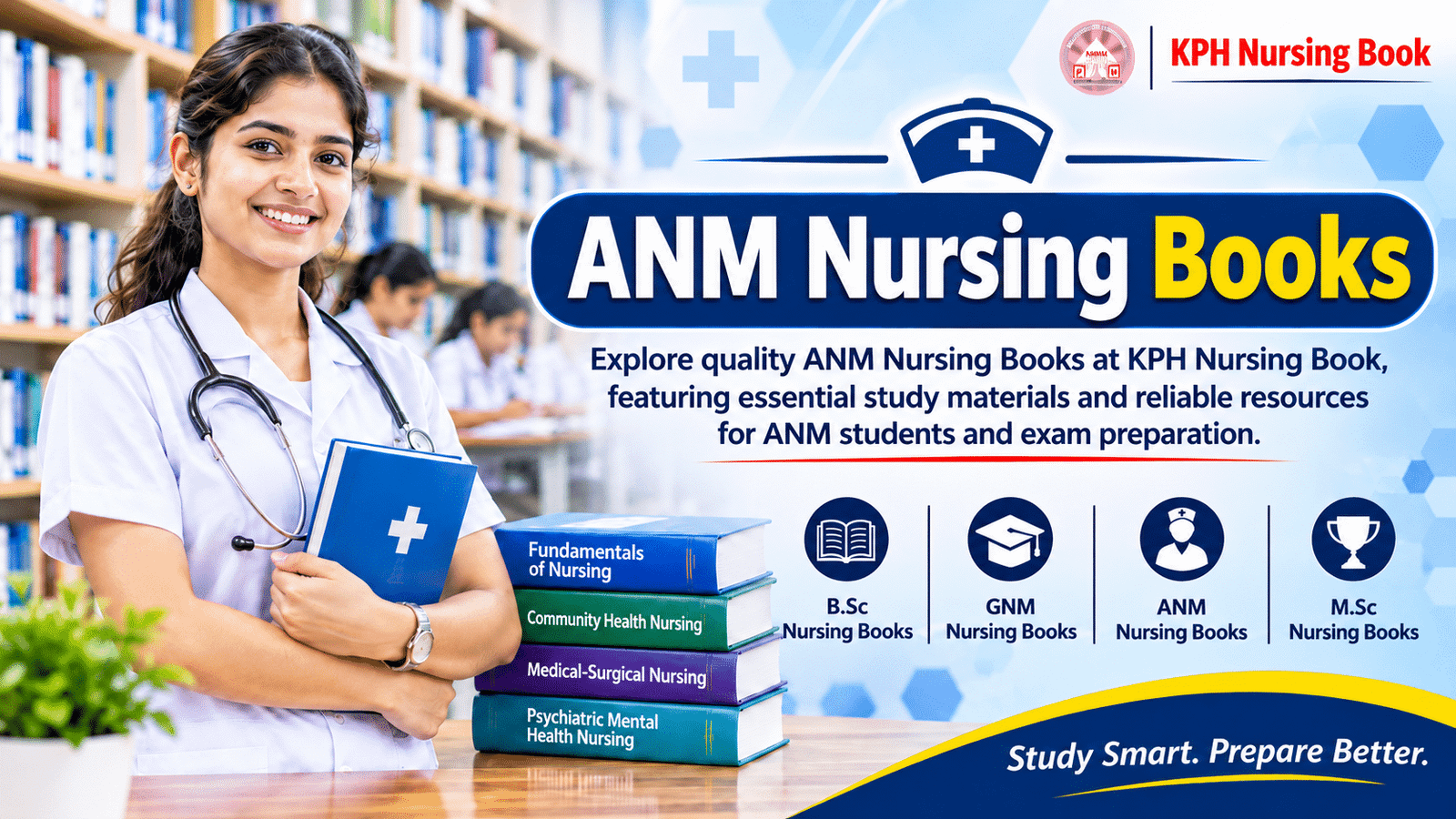
Many ANM students start the course with a long list of subjects and a short amount of time. Seniors give different advice, shops show many titles, and it is hard to know what is worth buying. The right ANM Nursing Books should make your learning simpler by matching your subjects, your language and your study style.
Quick answer: Pick one main textbook for each subject, add a short revision or case-based book where it helps, choose Hindi or English according to how you understand best, and always check your own syllabus before buying.
Understanding the ANM Course and Its Learning Requirements
What is the ANM course? ANM stands for Auxiliary Nurse Midwife. It is a nursing programme that prepares students for basic patient care, maternal and child health, and community-level health work. Course details such as duration and subject lists can vary by institute and state nursing council, so keep your official syllabus handy.
Why does book choice matter so much in ANM? The programme is practical and compact. There is less time to recover from a poor study choice. A clear book helps you understand the idea once and then use it in practice, rather than reading the same page again and again.
An ANM student may need to explain a nutrition tip to a mother, observe a child’s growth, or assist in a delivery room. In each case, basic knowledge from a textbook shapes how well you perform.
How the Right Nursing Books Support Academic and Practical Learning
Direct answer: A good book connects the idea (theory) with the action (practice), so you know what to do and why you do it.
- Concept clarity: Plain explanations help you understand instead of memorising.
- Practical readiness: Reading about a skill before you see it makes training sessions easier to follow.
- Exam support: Summaries, tables and diagrams make revision faster.
- Confidence: When you know the basics, patient interaction feels less stressful.
A simple habit helps: read the topic the night before a practical session, observe carefully the next day, then write two lines about what matched the book and what did not.
Important Subjects to Cover When Selecting ANM Textbooks
The KPH Nursing Book ANM category lists books for Anatomy and Physiology, Microbiology, Child Health and Paediatric Nursing, Midwifery, Behavioural Science, and Food and Nutrition. Here is what each subject means for you.
Anatomy and Physiology for Nursing Students
What is it? Anatomy is the structure of the body, and physiology is how that structure works.
This is the subject that supports everything else. If you understand the body, later topics like nutrition, child growth and midwifery become far easier.
Understanding Human Body Systems
Study one system at a time: the circulatory, respiratory, digestive, nervous and reproductive systems. For each, ask three things: what are the main parts, what do they do, and what happens when they do not work properly?
Learning Basic Body Functions
Link functions to daily life. Breathing, digestion, heartbeat and temperature control are things you can observe in yourself. Linking the book to your own body makes facts stick.
Why Conceptual Understanding Matters in Nursing Education
A nurse who understands why a pulse changes can notice problems early. A nurse who only memorised a number might miss them. Concepts help you handle situations that are not exactly like the book.
On KPH Nursing Book, you will find Anatomy and Physiology for Nurses and Paramedical Students as the main text, and Anatomy and Physiology At a Glance as a quick-revision option.
Anatomy, Physiology and Microbiology
What is Microbiology? It is the study of microorganisms such as bacteria, viruses and fungi, and how they relate to infection and health.
For nursing students, the practical value is infection control: hand hygiene, safe handling of equipment and understanding how diseases spread. A combined book can be useful when your syllabus groups these subjects together. The category lists Anatomy, Physiology & Microbiology for Nurses and Paramedical Students and an English and Hindi edition of the same subject.
Child Health and Paediatric Nursing
What is Child Health Nursing? It is the care of infants and children, including growth, development, feeding, immunisation and common childhood illnesses.
Look for clear sections on normal growth and development, because everything else builds on knowing what is typical for each age. The collection includes Child Health Nursing Exclusive for ANM Students and A Textbook of Paediatric Nursing. Students searching for Child Health Nursing Books can compare both against their syllabus.
Midwifery and Case-Based Learning
What is Midwifery? It is the care of women during pregnancy, childbirth and the period after delivery, along with care of the newborn.
Midwifery depends heavily on observation and decision-making. That is why case-based books are especially useful. The Case Book for Midwifery Students is listed on the site, along with a Hindi edition. A case book lets you practise thinking through real-style situations, which is excellent preparation for both exams and practical work.
How to use a case book:
- Read the case slowly.
- Write down what you would observe and do.
- Compare your answer with the book.
- Note what you missed.
Behavioural Science: Psychology and Sociology
What is Behavioural Science in nursing? It is the study of how people think, feel and behave, and how family and social surroundings affect health.
This subject trains you to communicate with patients, understand fear or anxiety, and respect different backgrounds. These skills matter as much as clinical knowledge. The site lists Behavioural Science for Nurses (Psychology & Sociology) and a Hindi version.
Food and Nutrition for Nurses
What is Nutrition in nursing? It is the study of nutrients, balanced diets and how food supports growth, recovery and daily health.
For ANM students, nutrition links directly to mothers and children. A Food and Nutrition for Nurses (Hindi) title is available in the category. Make simple tables of nutrients, food sources and deficiency signs for fast revision.
Should ANM Students Choose Hindi or English Nursing Books?
Direct answer: Choose the language in which you understand concepts fastest, then slowly learn the key English terms because hospital records and many exams use them.
Advantages of Hindi nursing books
- Easier first-time understanding of complex ideas.
- Less mental effort spent on translation.
- Helpful for students from Hindi-medium schools.
Advantages of English nursing books
- Direct exposure to medical and nursing terms.
- Smoother transition to later courses such as GNM or B.Sc. Nursing.
- Useful if your exams are in English.
What the KPH collection offers
The ANM category includes selected Hindi titles, such as Behavioural Science, the Midwifery Case Book and Food and Nutrition, plus an English and Hindi edition of Anatomy, Physiology & Microbiology. Not every subject has a Hindi edition, so check each product page before ordering.
A balanced method: read a topic in Hindi to understand, then write the English term beside it. Within a few weeks, your vocabulary grows naturally.
Nursing Books in Hindi and Nursing Books in English are not opposites. Many students use both depending on the subject.
How to Select Books According to Your ANM Syllabus
1. Check the latest syllabus
Get the current syllabus from your institute or state nursing council. Write down subject names and units.
2. Select books subject-wise
Match one main book to each subject. Avoid buying a book only because it looks thick or familiar.
3. Compare editions and languages
Check the title, edition and language on the product page. A “(Hindi)” or “English & Hindi” label tells you which version you are getting.
4. Choose theory and practical resources
Use a textbook for concepts and a case-based or practical-style book for application. Midwifery is a good example: pair your main subject book with a case book.
5. Keep revision material
Short, quick-reference books such as an “at a glance” title are useful in the last weeks before exams. They are not meant to replace full study.
Common Mistakes Students Make While Buying Nursing Books
- Buying unnecessary books. Too many titles create confusion and waste money.
- Ignoring the syllabus. A good book is useless if it does not cover your subject units.
- Not checking language or edition. You may end up with a book in a language that slows you down.
- Skipping fundamentals. Anatomy, Physiology and Behavioural Science may feel basic, but they support every other subject.
- Relying only on short notes. Quick revision material helps, but only after you have understood the topic from a proper book.
How to Build an Effective ANM Study Routine
Direct answer: Study a little every day, revise on a schedule, and connect reading with practical sessions.
For theory
- Study one subject block at a time.
- Write short notes after every chapter.
- Make small tables for lists such as nutrients, developmental milestones or infection types.
For revision
- Revise after one day, one week and one month.
- Redraw simple diagrams from memory.
- Use at-a-glance books for the final round.
For practical learning
- Read the topic before the session.
- After the session, compare what you saw with the book.
- Ask your instructor about differences.
For ANM examination preparation
- Finish the main syllabus first.
- Practise answering in your own words.
- Revise case-based topics aloud, as if explaining to a patient or a classmate.
Sample week
| Day | Focus |
|---|---|
| Mon–Thu | New topics from textbooks |
| Fri | Revision of notes and diagrams |
| Sat | Case practice or self-test |
| Sun | Rest and light reading |
Explore ANM Nursing Books at KPH Nursing Book
If you prefer ordering online, KPH Nursing Book has a dedicated ANM Nursing Books category with 52 listed products, including titles from Kumar Publishing House. The site presents itself as the online store of Kumar Publishing House.
Titles listed on the category page include:
- Anatomy and Physiology for Nurses and Paramedical Students
- Anatomy and Physiology At a Glance for Nurses and Paramedical Students
- Anatomy, Physiology & Microbiology for Nurses and Paramedical Students (also in English and Hindi)
- Child Health Nursing Exclusive for ANM Students
- Case Book for Midwifery Students (with a Hindi edition)
- Behavioural Science for Nurses (Psychology & Sociology), also in Hindi
- A Textbook of Food & Nutrition for Nurses (Hindi)
Prices on the page are shown after a discount on the printed MRP. To order, open the book you want, add it to the cart and complete checkout on the website. Because prices and availability can change, check the product page before you order.
When you finish your ANM course and plan further study, you can also explore GNM Nursing Books or B.Sc. Nursing Books on the same website.
Frequently Asked Questions About ANM Nursing Books
1. Which subjects should ANM students study?
ANM students commonly study Anatomy and Physiology, Microbiology, Child Health, Midwifery, Behavioural Science and Nutrition, along with other subjects in the syllabus. Confirm the exact list with your institute.
2. Which books are useful for ANM students?
Books for Anatomy and Physiology, Child Health Nursing, Midwifery case practice, Behavioural Science and Food and Nutrition are useful. The KPH category lists titles for each of these areas.
3. Are Hindi nursing books available?
Yes. Selected titles are available in Hindi, including Behavioural Science, the Midwifery Case Book and Food and Nutrition. Some are also available as English and Hindi editions.
4. Why are Anatomy and Physiology important?
They explain how the body is built and how it works. Without this base, it becomes difficult to understand child health, midwifery, nutrition and infection control.
5. Which book can help with Midwifery learning?
The Case Book for Midwifery Students is a practical companion for learning through situations. It works best alongside your main subject book.
6. How should students select ANM textbooks?
Start with your syllabus, choose one main book per subject, check the language and edition, and add revision or case-based material only where you need it.
7. Can students buy nursing books online?
Yes. On KPH Nursing Book, you open the book page, click Add to Cart and complete checkout. You can order several books together.
8. How can students prepare effectively for ANM examinations?
Finish the syllabus subject by subject, make short notes, revise on a schedule, practise answers in your own words and link theory with practical sessions.
Conclusion
Strong nursing practice starts with strong basics. The best study material for you is the material that matches your syllabus, speaks in a language you understand and supports both theory and practical work. A small set of well-chosen ANM Nursing Books will help you more than a pile of random titles.
If you are ready to build your study collection, visit KPH Nursing Book and explore the ANM category, compare the subject-wise titles with your syllabus, and choose the Hindi or English editions that make learning easier for you.