No products in the cart.

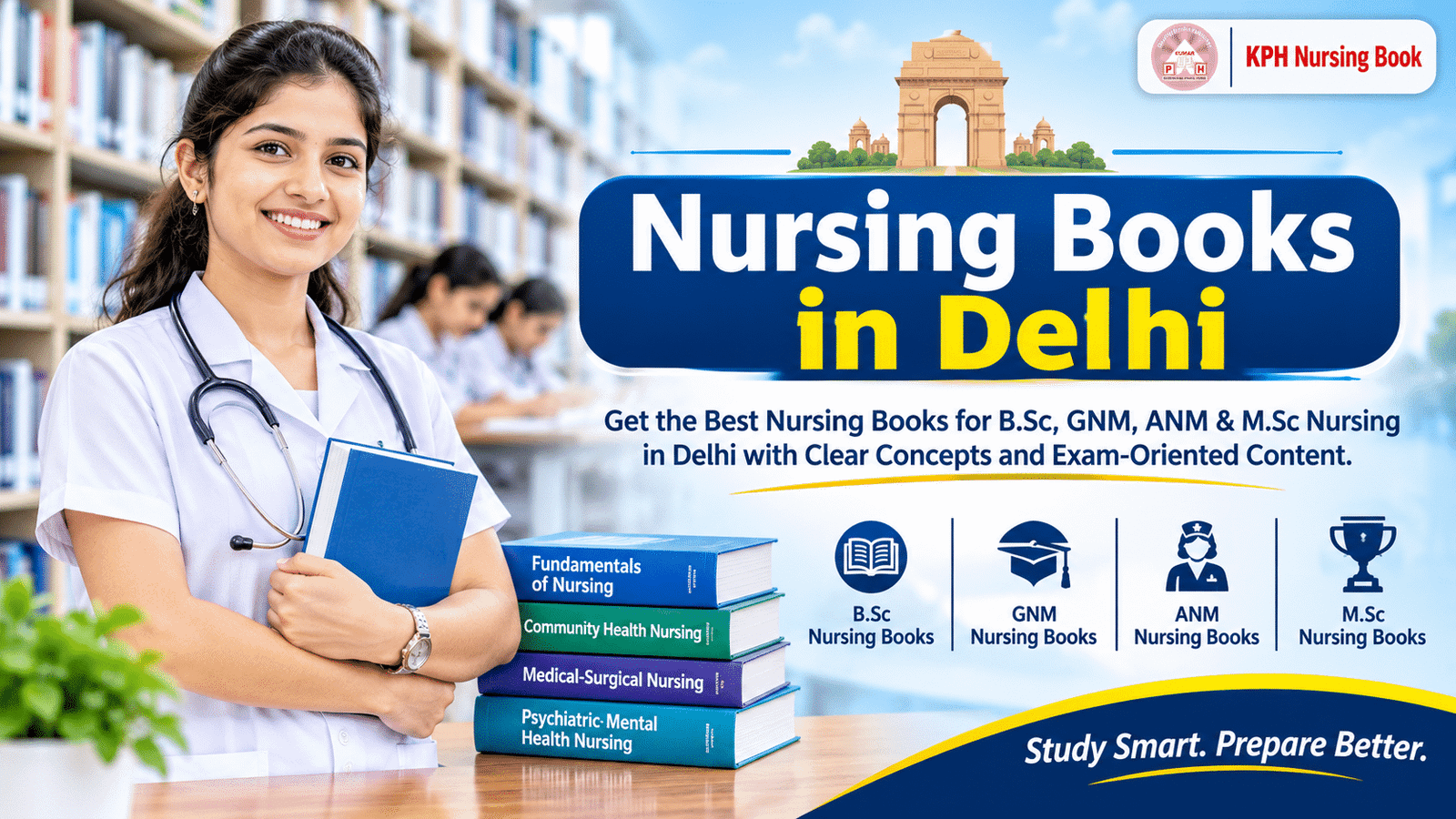
If you are a nursing student in the capital, you probably know the feeling of the first month in college: a long syllabus, a few suggestions from seniors, and no clear idea which books to buy. Finding the right Nursing Books in Delhi is less about visiting more shops and more about knowing what to look for.
Quick answer: To choose well, start with your official syllabus, pick one reliable core textbook per subject, check that the edition is recent, and add reference or practice books only when a topic needs extra support. This approach works for every course, from ANM to MSc.
Think of this article as a planning tool. Instead of listing titles, it shows you how to build a bookshelf that grows with your course.
Understanding the Role of Nursing Books in Professional Education
Direct answer: Nursing textbooks give you the verified, organised knowledge that safe patient care depends on. Lectures and online videos help, but a good book is the one resource you can return to at any hour.
Why textbooks remain important in nursing education
Classroom notes are often brief, and online content varies in quality. A well-written textbook is reviewed, structured and consistent. It explains a topic from basic definition to nursing care, which is exactly the order in which you need to understand it.
Textbooks also help you build your own sense of the subject. When you read a chapter slowly, you notice links between topics: how nutrition connects to wound healing, or how community health connects to child immunisation.
How theoretical knowledge connects with practical clinical training
Imagine you are posted in a medical ward. A patient has high blood sugar, and the staff nurse asks you to check the reading and observe the patient. If you have studied diabetes in your Medical-Surgical Nursing textbook, you already know the signs to watch, why diet and medicines matter, and what to report. You are not just following instructions. You are understanding them.
That is the real value of theory. It turns observation into learning.
Importance of selecting books according to the nursing course
An ANM student and an MSc student may both study “community health,” but at very different depths. A book written for degree-level study may overwhelm a diploma student, and a basic book may not satisfy a postgraduate student. Matching the book to your course level saves time and prevents confusion.
How to Identify the Right Nursing Books in Delhi
Direct answer: The right book matches your current syllabus, is written in language you can follow, uses clear visuals, and comes from a recent edition. Price and popularity should come last.
Students searching for Nursing Books in Delhi often compare many options at once. A short, repeatable checklist keeps the decision simple.
Check the latest course syllabus
Ask your college for the current syllabus document and keep a copy. Compare the contents page of any book with your unit list. If a book skips major units or covers a different curriculum, it is not the right fit.
Understand subject-wise requirements
Each subject asks for something different:
- Science subjects (Anatomy, Physiology, Microbiology) need strong diagrams.
- Clinical subjects (Fundamentals, Medical-Surgical) need clear procedures and care plans.
- Community and mental health subjects need current guidelines and good case examples.
Evaluate the author’s experience and book editions
Authors with teaching or clinical experience in nursing usually write in a way that suits students. Look at the author information and the edition year. This matters most for pharmacology, community health and anything linked to health programmes and guidelines.
Look for diagrams, case studies, illustrations and practice questions
A good book includes:
- Labelled diagrams and flowcharts
- Short case examples
- Summary boxes at the end of chapters
- Review questions for self-testing
A quick two-minute test
Open any chapter on a topic you already know well. If the explanation is accurate, clear and easy to follow, the book is likely a good match for your reading style.
Consider readability and examination preparation
Dense paragraphs may look impressive, but they slow learning. Prefer books with short paragraphs, headings and lists. If your exams include MCQs or viva, check whether the book supports that style of preparation.
Course-Wise Nursing Books for Different Academic Levels
Each course has a different duration, depth and goal. Course details and subject lists can change, so verify them with your institution or nursing council before buying.
| Course | Level | Book style that suits best |
|---|---|---|
| ANM | Certificate | Simple, practical, community-focused |
| GNM | Diploma | Clinical, procedure-based, easy language |
| BSc Nursing | Undergraduate degree | Detailed, research-aware, evidence-based |
| MSc Nursing | Postgraduate degree | Advanced, analytical, research and leadership focused |
BSC Nursing Books for Undergraduate Students
Direct answer: BSC Nursing Books should balance science foundations, clinical nursing and community health, with enough depth for a degree-level programme.
BSc Nursing is a four-year programme. The study load increases each year, so planning books by year helps.
Important subjects covered in BSc Nursing
Anatomy and Physiology
These form the base for every clinical subject. Choose books with clear diagrams and simple explanations of body systems.
Nutrition and Biochemistry
Look for tables of nutrients, food sources and deficiency conditions. These are easy to revise and often asked in exams.
Medical-Surgical Nursing
This is usually the largest subject. Pick a book that connects disease causes, signs, treatment and nursing care in one flow. Care plans and case examples are a big advantage.
Child Health Nursing
Search for books that explain growth, development, common childhood illnesses and immunisation in an easy sequence.
Obstetrics and Gynaecological Nursing
Choose resources with clear sections on antenatal, intranatal and postnatal care, along with common complications.
Nursing Research and Community Health Nursing
Research books should explain concepts like sampling and data collection with simple examples. Community health books should reflect current programmes and public health practice.
GNM Nursing Books for Diploma Students
Direct answer: GNM Nursing Books should be easy to read, practice-oriented and structured around ward and community care.
GNM (General Nursing and Midwifery) combines classroom learning with long clinical postings. Students need books they can read quickly before a posting and use again afterwards.
Essential subjects for GNM students
- Fundamentals of Nursing: Basic procedures and patient care.
- Medical-Surgical Nursing: Adult patient care in medical and surgical conditions.
- Community Health Nursing: Prevention, health education and community care.
- Mental Health Nursing: Understanding and supporting patients with mental health conditions.
- Midwifery and Child Health Nursing: Maternal and child care from pregnancy to childhood.
How to use GNM books during postings
Before a posting, read the related procedure. After each shift, write two or three lines about what you observed and what the book says. This simple habit connects reading with practice.
ANM Nursing Books for Auxiliary Nursing Students
Direct answer: ANM Nursing Books should present basic concepts in simple language and focus on maternal and child health, community work and preventive care.
ANM (Auxiliary Nurse Midwife) training prepares students for frontline roles in communities and primary health settings.
Key learning areas
- Basic nursing concepts: Hygiene, vital signs and infection prevention.
- Maternal and child healthcare: Antenatal care, safe delivery practices, newborn care and immunisation.
- Community health fundamentals: Health education, family health and record keeping.
- Nutrition and first aid: Balanced diet, common deficiencies and emergency response.
- Preventive and primary healthcare: Early detection, referral and routine community care.
For this course, short sentences, pictures and practical examples are more useful than heavy theory.
MSc Nursing Books for Postgraduate Students
Direct answer: MSc study material should support advanced clinical understanding, research skills, education and leadership, going beyond what undergraduate books cover.
Postgraduate nursing is about analysis, specialisation and leadership. Students often work on research projects, write dissertations and prepare for teaching or managerial roles.
Useful categories typically include:
- Advanced nursing practice resources for the chosen specialty
- Nursing research and statistics
- Nursing education and curriculum development
- Nursing management and administration
If you are planning postgraduate study, you can explore the MSc Nursing Books category and compare titles with your programme requirements. At this level, choose books that help you question and apply concepts, not just memorise them.
Subject-Wise Books Every Nursing Student Should Explore
Some subjects appear in several courses. These three come up often in student searches.
Fundamental of Nursing Books
What is Fundamentals of Nursing? It is the subject that teaches the core principles and skills of patient care. Almost every other nursing subject builds on it.
Direct answer: Fundamental of Nursing Books should explain procedures step by step, with the reason behind each action and a strong emphasis on safety.
Topics to look for
- Basic nursing procedures: Bed-making, positioning, feeding, medication administration and wound care.
- Hygiene and patient comfort: Bathing, oral care, skin care and comfort measures.
- Vital signs: Temperature, pulse, respiration and blood pressure, with normal ranges.
- Infection prevention: Hand hygiene, use of protective equipment and safe waste handling.
- Nursing ethics: Patient rights, privacy, consent and professional conduct.
A good test is the procedure layout. If each procedure lists the purpose, the articles needed, the steps and the points to remember, the book is serving you well.
Psychiatric Mental Health Nursing Books
What is Psychiatric Mental Health Nursing? It is the area of nursing that supports people with mental health conditions through assessment, care and communication.
Direct answer: Psychiatric Mental Health Nursing Books should explain assessment, common disorders and therapeutic communication in a clear, respectful way.
What good books cover
- Mental health assessment: Observing behaviour, mood, thinking and speech.
- Psychological disorders: Depression, anxiety, schizophrenia, bipolar disorder and substance-related conditions.
- Therapeutic communication: Active listening, empathy, open-ended questions and non-judgmental responses.
- Psychiatric nursing procedures: Safe care during admission, observation, medication and crisis situations.
- Patient support: Family involvement, rehabilitation and relapse prevention.
Books with short case examples help a lot here, because the subject is easier to understand when you can picture a real conversation.
Community Health Nursing Books
What is Community Health Nursing? It is nursing practice that aims to protect and improve the health of families and communities, not only individual patients.
Direct answer: Community Health Nursing Books should cover public health principles, disease prevention, primary healthcare and community-based practice.
Core topics
- Public health and epidemiology: How diseases spread and how they are tracked.
- Vaccination: Immunisation schedules and safe practices.
- Maternal healthcare: Antenatal and postnatal care at the community level.
- Disease prevention: Levels of prevention, screening and health promotion.
- Health education: How to teach families about hygiene, nutrition and early warning signs.
- Community-based practice: Home visits, health centre functioning and record keeping.
Since guidelines and programmes get updated, always prefer a recent edition for this subject.
Physical Books vs Digital Learning Resources
Direct answer: Printed books are best for deep study and note-making, while digital resources help with quick lookup and visual revision. A balanced mix usually works best.
Benefits of printed textbooks
- Comfortable for long study sessions.
- Easy to highlight, annotate and bookmark.
- No battery or internet needed during revision.
How digital resources support revision
- Quick search for definitions and terms.
- Videos and animations for procedures.
- Portable access to short notes on your phone.
Using textbooks alongside online learning materials
Read the chapter first. Then watch a short, reliable video on the same topic to fill gaps. Finally, test yourself with practice questions. This order keeps the textbook as your main source and treats online material as support.
Choosing a balanced study approach
| Situation | Better choice |
|---|---|
| First-time learning of a topic | Printed textbook |
| Last-minute revision | Short notes, digital summaries |
| Understanding a procedure visually | Video plus textbook |
| Long study sessions | Printed book |
Common Mistakes Students Make When Buying Nursing Textbooks
Many students waste money and time on avoidable errors. Here are the ones to watch for when searching for Nursing Books in Delhi or anywhere else.
Purchasing books without checking the syllabus
A book may be well written and still cover the wrong content. Always compare its contents page with your syllabus first.
Selecting outdated editions
Older editions may include outdated drug information or programme details. Check the publication year, and ask your teachers if you are unsure about a particular subject.
Buying unnecessary reference books
Reference books are helpful for difficult topics, but too many create confusion. Start with one main textbook per subject, then add extras only when needed.
Ignoring subject fundamentals
Some students rush toward advanced or exam-focused books and skip fundamentals. Weak basics make later subjects harder.
Choosing books only because of popularity
A book that works for a friend may not match your course, your pace or your reading style. Choose based on suitability, not hype.
How Nursing Books Support Practical Knowledge and Clinical Confidence
Direct answer: Books help you understand why each clinical step is taken, which builds confidence and reduces mistakes during practice.
Understanding procedures
Before a procedure, read its purpose, preparation and steps. After watching it on the ward, compare the two. If you noticed a difference, ask your instructor why.
Patient communication
Communication skills are taught in Fundamentals and Mental Health Nursing. Practise sentences you might use when explaining a procedure to a patient in simple language.
Clinical responsibilities
Books outline what nurses must record, report and escalate. Reading these sections early helps you avoid common documentation errors.
Evidence-based nursing practice
Evidence-based practice means using the best available research along with clinical judgment. Degree and postgraduate books often introduce this idea, and it grows more important as you advance in the course.
Exploring Nursing Book Categories at KPH Nursing Book
Students often spend hours comparing listings across different places. A category-based website can narrow the search.
KPH Nursing Book is a website where nursing students can explore nursing-related educational books by academic category. Students can start with the category that matches their course, such as BSc, GNM, ANM or MSc, and then check subject areas like Fundamental of Nursing, Psychiatric Mental Health Nursing and Community Health Nursing. You can visit kphnursingbook.in to see which categories and titles are currently listed.
A simple way to use it:
- Note your course, year and current syllabus.
- Open the category that matches your course.
- Compare the subjects and book details with your syllabus.
- Confirm edition and suitability with your teachers before finalising.
Details such as availability and ordering should always be checked on the website itself.
Smart Tips for Building a Useful Nursing Book Collection
Start with prescribed textbooks
Your first purchases should be the books recommended in your syllabus or by your faculty. These keep your study aligned with your exams.
Organise books semester-wise
Keep the current semester’s books together. A small shelf or box per semester saves search time and reduces last-minute stress.
Maintain subject-wise notes
Use one notebook or folder per subject. Write short summaries, key definitions and doubts. These notes become your quick revision tool.
Use reference books for difficult topics
If a chapter remains unclear after two readings, consult a reference book. Read only the relevant section instead of the entire book.
Revise important diagrams and concepts regularly
Redraw diagrams such as the heart, nephron or reproductive system from memory once a week. Active recall builds stronger memory than re-reading.
Sample weekly plan
- Monday to Thursday: Learn new topics from your textbook.
- Friday: Revise the week’s notes and diagrams.
- Saturday: Attempt practice questions.
- Sunday: Rest and light revision.
Frequently Asked Questions About Nursing Books in Delhi
1. Where can students explore Nursing Books in Delhi?
Students can explore Nursing Books in Delhi through college libraries, faculty recommendations, local book markets and educational book websites. KPH Nursing Book lets students browse nursing categories online and compare them with their syllabus.
2. Which books are important for BSc Nursing students?
Core books include Anatomy and Physiology, Fundamentals of Nursing, Medical-Surgical Nursing, Child Health Nursing, Community Health Nursing and Nursing Research. Choose according to your current syllabus.
3. What are the essential books for GNM Nursing?
GNM students need books on Fundamentals of Nursing, Medical-Surgical Nursing, Community Health Nursing, Mental Health Nursing, Midwifery and Child Health. Prefer practical, easy-to-read titles.
4. Which books should ANM students study?
ANM students should study books covering basic nursing skills, maternal and child health, community health, nutrition and first aid. Simple language and illustrations help most.
5. Why are Fundamental of Nursing Books important?
Fundamental of Nursing Books teach the basic procedures, safety practices and principles used throughout nursing. A strong foundation makes later subjects easier and supports better clinical performance.
6. Which subjects are covered in Psychiatric Mental Health Nursing Books?
They usually cover mental health concepts, assessment, common disorders, therapeutic communication, psychiatric nursing care and patient and family support.
7. What topics are explained in Community Health Nursing Books?
They explain public health, epidemiology, immunisation, maternal and child health, disease prevention, health education and community-based nursing practice.
8. How should students select nursing textbooks?
Match the book to your syllabus, check the edition, read a sample chapter, look for diagrams and practice questions, and choose a style you can read comfortably.
9. Are reference books necessary for nursing examinations?
They are helpful but not always necessary. A good prescribed textbook is usually enough for most subjects. Use reference books for difficult topics, assignments or advanced study.
10. How can students choose books according to their nursing syllabus?
Make a list of subjects and units from the official syllabus, then compare each book’s contents page with that list. Select books that cover your units at the right depth for your course.
Conclusion: Choosing the Right Books for a Successful Nursing Journey
Nursing education depends on understanding as much as practice. The books you choose shape how clearly you grasp concepts, how confidently you perform in clinical settings and how calmly you prepare for exams. Matching books to your course, checking editions, building a strong foundation in subjects like Fundamentals, Mental Health and Community Health, and avoiding unnecessary purchases will serve you throughout your studies.
For students searching for Nursing Books in Delhi, the goal is not to gather the most books but the right ones. KPH Nursing Book offers a convenient place to explore nursing book categories by course, so you can compare options with your syllabus and decide with confidence.