No products in the cart.

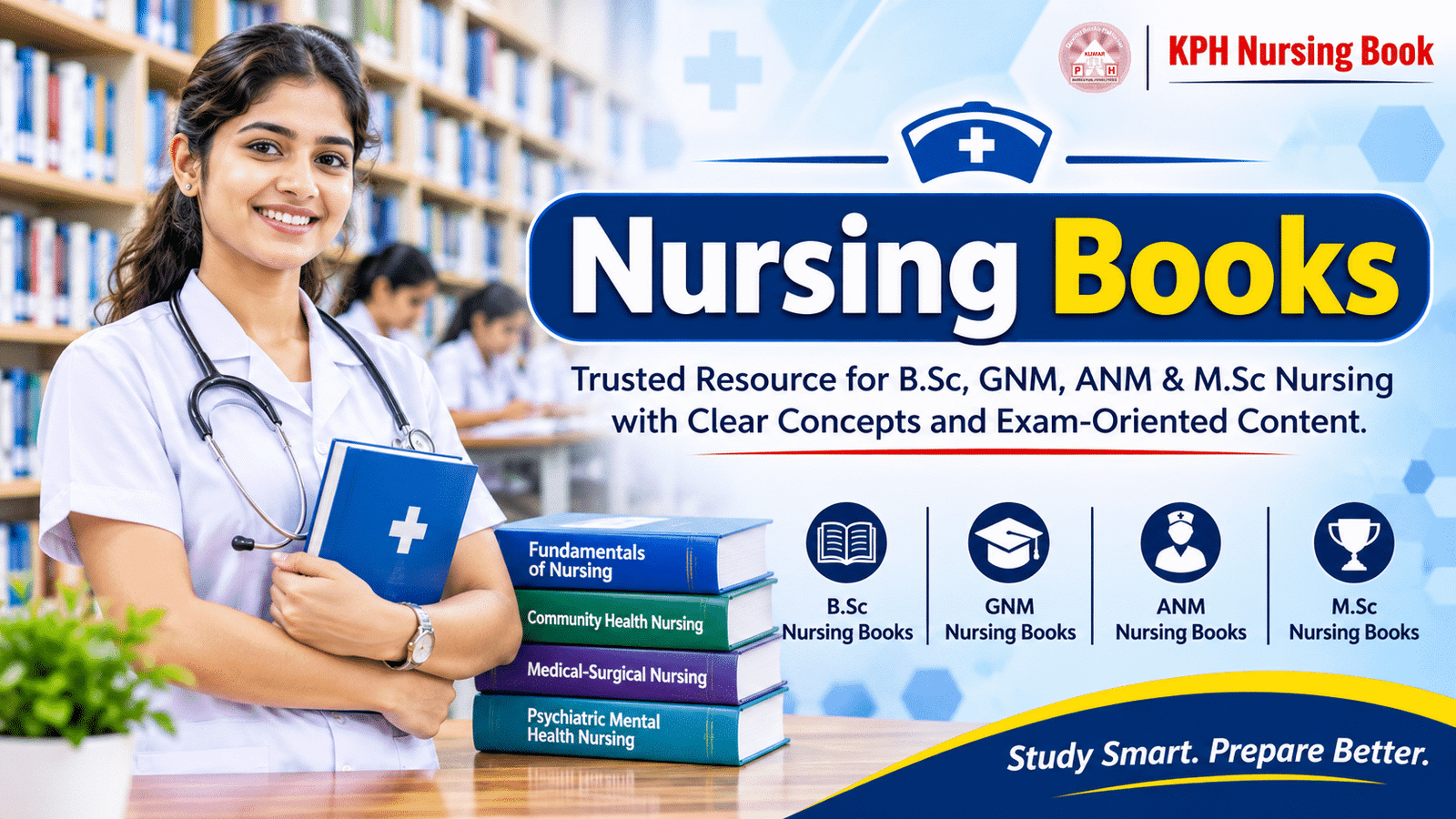
Walk into any nursing college in the first week of a new session and you will hear the same question from every student: “Which books should I buy?” The answer matters more than it seems. The right Nursing Books shape how well you understand the human body, how confidently you perform procedures on the ward, and how calmly you face your exams.
Quick answer: Choose books that match your current syllabus, explain concepts in language you understand, and cover both theory and clinical practice. The best book is not always the thickest or the most expensive. It is the one you will actually read, revise and trust.
This guide walks you through course-wise and subject-wise book selection for BSc, GNM and ANM students, along with practical buying advice, common mistakes and answers to frequently asked questions.
Why Choosing the Right Nursing Books Matters for Students
Direct answer: The right books give you accurate theory, connect that theory to patient care, and give you a dependable base for exam preparation. Weak or mismatched study material can leave gaps that only show up when you are already under pressure.
Importance of theoretical knowledge
Nursing is not only about skills. Every procedure you perform rests on a body of knowledge: why a medicine is given at a particular time, why a patient is positioned a certain way, why one sign is urgent and another is not. Theory is what lets you make safe decisions when a situation does not look exactly like the textbook.
A good textbook builds that theory in layers. It starts with definitions, moves to causes and signs, then explains care and ends with evaluation. When a book follows this logic, you learn faster and remember longer.
Connection between textbooks and clinical practice
Many students treat the classroom and the ward as two separate worlds. In reality, they feed each other.
Consider a student who reads about post-operative care before a surgical ward posting. When she sees a patient being monitored for pain, wound condition and breathing, she recognises the reasons behind each check. Another student who skipped the chapter only watches and copies. Both are present on the ward, but only one is learning with understanding.
Books support clinical practice in three ways:
- They explain the reason behind each step of a procedure.
- They give you a reference for normal values, signs and precautions.
- They help you reflect after a clinical shift and fill gaps in what you observed.
How the right study material improves exam preparation
Nursing exams test understanding, recall and application. Study material that is clear, organised and syllabus-focused makes all three easier.
- Understanding: Clear explanations and diagrams.
- Recall: Summaries, tables and key-point boxes for revision.
- Application: Case examples and practice questions that show how concepts are tested.
When your books fit your syllabus, you spend your limited study hours on what matters.
Different Nursing Courses and Their Essential Study Materials
India offers several routes into nursing, mainly ANM, GNM and BSc Nursing. Each has a different level, duration and focus, so study material also needs to differ. Course details and subject lists can change, so always confirm your current syllabus with your institution or nursing council before buying.
BSC Nursing Books for Undergraduate Nursing Students
Direct answer: BSC Nursing Books should offer detailed theory, nursing process-based explanations and enough clinical and research content to match a degree-level programme.
BSc Nursing is a four-year undergraduate programme. It builds a broad foundation in sciences, nursing practice, community health and management, and it gives more attention to research and leadership than diploma courses.
Important subjects and study requirements
Subjects vary by year, but students commonly study areas such as:
- Anatomy and Physiology
- Nutrition and Biochemistry
- Fundamentals of Nursing
- Microbiology and Pharmacology
- Medical-Surgical Nursing
- Child Health Nursing
- Mental Health Nursing
- Community Health Nursing
- Midwifery and Obstetrical Nursing
- Nursing Research and Management
Books for theory, practicals and examinations
Think of your BSc study material in three layers:
- Core textbooks for each subject, used for regular learning.
- Practical and procedure resources with step-by-step explanations for lab and clinical work.
- Revision and practice material for exam preparation, used after you have understood a topic.
How students can select appropriate textbooks
- Match the book to your university or council syllabus.
- Read a sample chapter to judge language and clarity.
- Look for care plans, diagrams and summary points.
- Prefer a recent edition for drugs, guidelines and programmes.
You can browse the BSC Nursing Books category to compare available titles against your syllabus.
GNM Nursing Books for General Nursing Students
Direct answer: GNM Nursing Books should be practical, clearly written and focused on hospital and community care, because GNM is a diploma programme built around clinical skills.
GNM stands for General Nursing and Midwifery. It is typically a three-and-a-half-year programme in which students move between classroom learning and extended clinical postings.
Essential subjects covered in the GNM course
Commonly covered areas include:
- Biological and behavioural sciences
- Fundamentals of Nursing
- Community Health Nursing
- Medical-Surgical Nursing
- Child Health Nursing
- Mental Health Nursing
- Midwifery and Gynaecological Nursing
Importance of practical learning
GNM students spend a large part of the course on the ward. Books that describe procedures in clean, numbered steps are far more useful than books that only discuss theory. After each posting, compare what you saw with what you read, and note any difference to ask your clinical instructor.
Recommended categories of study materials
- Subject-wise textbooks written in simple English
- Procedure manuals and clinical handbooks
- Short revision notes
- Practice question sets for each subject
ANM Nursing Books for Auxiliary Nursing Students
Direct answer: ANM Nursing Books should explain basics clearly and connect directly to primary healthcare, maternal care and child health, which are the core of the programme.
ANM stands for Auxiliary Nurse Midwife. It is a shorter programme that prepares students for frontline work in sub-centres, primary health centres and communities.
Basic nursing knowledge
Students begin with essentials such as human body basics, hygiene, nutrition, first aid and infection prevention. Books for this stage should use short sentences, simple examples and clear pictures.
Maternal and child healthcare
This is a central area of ANM work. Look for material that explains antenatal care, safe delivery practices, postnatal care, newborn care, immunisation and growth monitoring in an easy, step-by-step manner.
Community-based nursing education
ANMs often work close to the community, so books that explain health education, family planning, disease prevention and record keeping are especially useful. Practical examples, such as how to counsel a family on nutrition, make the learning easier to apply.
Subject-Wise Nursing Books Every Student Should Know About
Whatever course you choose, certain subjects form the backbone of nursing education. Below are three that students frequently search for.
Fundamental of Nursing Books
What is Fundamentals of Nursing? It is the subject that teaches the basic principles, skills and attitudes required to care for patients. Almost everything you learn later builds on it.
Direct answer: Fundamental of Nursing Books should explain basic procedures step by step, with reasons behind each action and a clear focus on patient safety.
Basic nursing procedures
These books typically cover bed-making, hygiene care, vital signs, positioning, medication administration, wound care and infection control. Choose a book that shows each procedure with a purpose, a list of requirements, the steps and the points to remember.
Patient care and safety
Look for chapters on hand hygiene, preventing falls, safe handling of equipment, and observation and reporting. These topics teach habits that protect both patients and nurses.
Nursing principles and clinical responsibilities
A strong book also explains the nursing process (assessment, diagnosis, planning, implementation and evaluation), documentation, communication and basic ethics.
Example for practice
Take “checking blood pressure.” A good book will tell you why the reading matters, how to prepare the patient, how to place the cuff, what to record and when to report abnormal readings. If your book gives all of this clearly, it is doing its job.
Psychiatric Mental Health Nursing Books
What is Psychiatric Mental Health Nursing? It is the branch of nursing that focuses on caring for people with mental health conditions, supporting recovery and promoting emotional well-being.
Direct answer: Psychiatric Mental Health Nursing Books should explain mental health concepts in plain language, describe common disorders and their care, and teach therapeutic communication.
Mental health concepts
Look for clear explanations of mental health, mental illness, stress, coping and the factors that affect them. Books that avoid heavy jargon make this subject far less intimidating.
Psychiatric disorders and patient care
Good books describe disorders such as depression, anxiety disorders, schizophrenia and substance-related conditions, including signs, treatment approaches and nursing care. Case-style examples help you picture how a patient might present.
Therapeutic communication and nursing responsibilities
Communication is a core nursing tool in this subject. Choose books that explain active listening, empathy, maintaining boundaries, observation and documentation, along with legal and ethical responsibilities.
Community Health Nursing Books
What is Community Health Nursing? It is the practice of promoting health and preventing disease among families and populations, outside as well as inside hospitals.
Direct answer: Community Health Nursing Books should cover public health principles, disease prevention, primary healthcare and the practical work nurses do in communities.
Public health education
Expect topics such as health and its determinants, epidemiology basics, environmental health, sanitation, nutrition and health education.
Disease prevention
Look for clear coverage of levels of prevention, immunisation, screening, communicable and non-communicable diseases, and outbreak response.
Primary healthcare and community nursing practices
This part covers health centre functioning, home visits, family health care, record keeping and national health programmes. Because programmes and guidelines get updated, prefer recent editions for this subject.
How to Choose the Best Nursing Books for Your Course
Choosing the best Nursing Books is easier when you follow a simple checklist instead of buying by name or price alone.
1. Check the latest syllabus
Start with the official syllabus from your college, university or nursing council. List your subjects and match each book against it. A book that covers only part of a topic can be as risky as one that covers too much.
2. Consider the author’s experience
Authors with a teaching or clinical background in nursing generally explain concepts in a way that fits what students need. Check the author details inside the book or on the publisher’s page.
3. Check the edition and publication details
Edition and publication year matter, especially for pharmacology, community health and any subject tied to guidelines. Older editions can still work for stable topics, but confirm with your teachers when in doubt.
4. Understand the subject coverage
Read the table of contents. Ask yourself: does this book cover each unit in my syllabus, with enough depth for my course level?
5. Select books according to examination requirements
If your exams stress theory, choose books with strong explanations. If they include practical or viva components, look for procedure guides and clinical examples. Add a question bank only after the textbook is in place.
Quick test: Open a page on a topic you already know. If the explanation feels accurate and easy to follow, the book probably suits your reading style.
Physical Books vs Digital Study Resources
Direct answer: Printed textbooks support deep, focused study and note-making, while digital resources help with quick lookup and flexibility. Many students do best with a mix of both.
Advantages of printed textbooks
- Easier to read for long periods without screen fatigue.
- Simple to highlight, underline and add notes.
- No dependence on battery or internet connection.
- Helpful for open revision, where you flip back and forth between pages.
Benefits of digital learning resources
- Searchable, which helps when you need a quick definition.
- Lightweight, so you can carry several resources at once.
- Useful for videos, animations and updated information.
Why a combination of both can support nursing education
Use printed books as your main study source and digital resources to clarify difficult topics. For example, after reading about a procedure, a short demonstration video can help you picture the steps. Just make sure digital material comes from a reliable educational source and fits your syllabus.
| Feature | Printed books | Digital resources |
|---|---|---|
| Best for | Deep study, notes | Quick lookup, visual support |
| Access | Anytime | Needs a device |
| Annotation | Easy by hand | Depends on the platform |
| Risk | Outdated edition | Unverified content |
Common Mistakes Students Should Avoid When Buying Nursing Books
Even careful students make buying mistakes. Here are the most common ones, and how to avoid them.
Purchasing outdated editions
Medicine and public health change. An old edition may carry outdated drug information or programme details. Check the publication year, and ask your faculty when you are unsure.
Selecting books without checking the syllabus
A popular title is not always the right title. Always cross-check the contents against your own syllabus, not a classmate’s.
Ignoring practical and clinical subjects
Some students spend all their budget on theory and forget procedure and clinical resources. Since nursing is a practice-based profession, practical learning deserves equal weight.
Buying unnecessary reference materials
Reference books are useful, but too many create confusion. One main textbook per subject is usually enough. Add a reference book only when you need extra detail on a topic.
Studying only from exam guides
Question banks and short notes help with revision, but they cannot replace the understanding gained from a full textbook. Use guides after you have learned the topic properly.
How KPH Nursing Book Helps Students Find Relevant Study Materials
With so many titles in the market, students often waste time scrolling through general listings. A dedicated platform helps narrow the search.
KPH Nursing Book is a website where nursing students can explore nursing-related educational books by category. Its BSC Nursing Books section is a good starting point for undergraduate students who want to compare titles against their syllabus. Students looking for GNM Nursing Books, ANM Nursing Books or subject-wise resources such as Fundamental of Nursing Books, Psychiatric Mental Health Nursing Books and Community Health Nursing Books can visit kphnursingbook.in and check which categories and titles are listed for their course.
A simple way to use any such platform:
- Write down your course and current syllabus.
- Open the category that matches your course.
- Compare the subjects and book details with your syllabus.
- Confirm the edition and suitability with your teachers if needed.
Frequently Asked Questions About Nursing Books
1. Which Nursing Books are important for beginners?
Beginners should start with syllabus-based textbooks in Anatomy, Physiology and Fundamentals of Nursing. These subjects build the base for everything else. Choose books with simple language, labelled diagrams and clear procedure steps.
2. How can I choose the right books for BSC Nursing?
Begin with your university syllabus, then pick one main textbook for each subject. Check the edition, read a sample chapter and look for care plans and summary points. Add practice and revision material once your main textbooks are ready.
3. What are the essential books for GNM students?
GNM students benefit most from subject-wise textbooks written in simple English, along with procedure manuals for clinical postings. Key subjects include Fundamentals of Nursing, Community Health Nursing, Medical-Surgical Nursing, Child Health, Mental Health and Midwifery.
4. Which books are useful for ANM nursing students?
ANM students should focus on books covering basic nursing skills, maternal and child health, immunisation, nutrition and community health. Pictures, short explanations and practical examples make these books easier to use.
5. Why are Fundamental of Nursing Books important?
They teach the basic skills, principles and safety practices used in every area of nursing. Weak fundamentals can affect performance in later subjects and in clinical settings, which is why a clear, procedure-based book is valuable from the first semester.
6. Which books help students understand psychiatric nursing?
Look for Psychiatric Mental Health Nursing Books that explain concepts simply, describe common disorders with nursing care and teach therapeutic communication. Case-style examples help you remember how to apply the theory.
7. Are Community Health Nursing Books important for practical examinations?
Yes, in most courses. Community health includes field visits, health education and record keeping, which may be assessed in practical or viva exams. Books with clear, recent information on programmes and procedures support that preparation.
8. Where can students explore different nursing study materials?
Students can check their college library, ask teachers and seniors for recommendations, and explore educational book websites. KPH Nursing Book offers a BSC Nursing Books category and other nursing categories that students can browse and compare against their syllabus.
Conclusion – Build Strong Nursing Knowledge with the Right Books
Nursing education asks a lot: solid theory, confident clinical skills and steady exam performance. The books you choose can either support or slow that journey. When you pick study material that matches your syllabus, explains concepts clearly and balances theory with practice, learning becomes smoother and revision becomes less stressful.
Whether you are a BSc, GNM or ANM student, treat your study material as a long-term tool. Start with a reliable core textbook for each subject, keep editions and syllabus changes in mind, and avoid collecting more books than you can use. Well-chosen Nursing Books will not do the work for you, but they make hard work count.
If you are ready to start your search, KPH Nursing Book is a good place to explore nursing book categories relevant to your course. Compare options, check them against your syllabus and choose the books that help you learn with confidence.